Project Overview
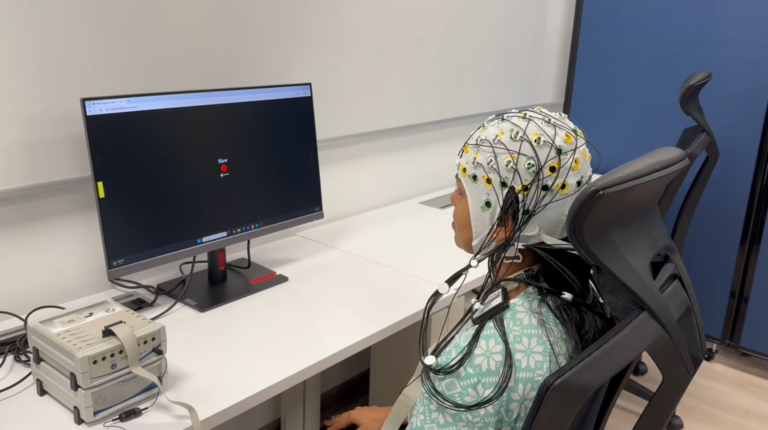
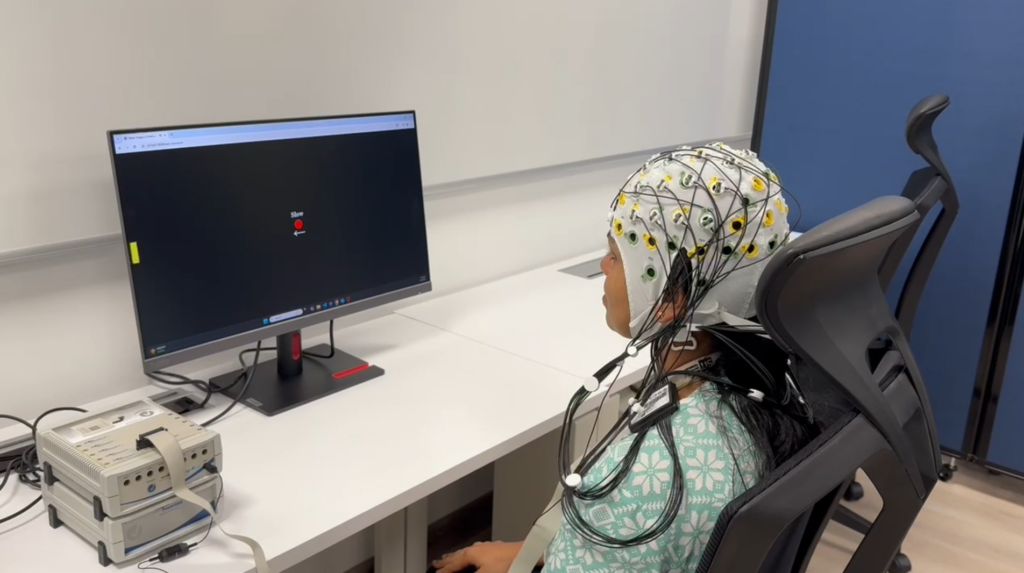
This project develops a non-invasive motor-imagery brain-computer interface that decodes imagined hand-movement kinematics and incorporates an online self-correction mechanism using the user’s brain response to visual neurofeedback.
Background and Motivation
Motor imagery is the mental imagination of movement without actual movement. Motor-imagery BCI can decode a user’s intention to move an affected limb and initiate assisted movement. Existing MI-BCI systems largely focus on bilateral movements or individual body parts, which limits degrees of freedom and can require extensive training. Decoding kinematic parameters such as movement direction and speed can support more natural control.
Objectives
- Develop a motor-imagery BCI to decode imagined hand-movement directions and speed.
- Integrate an automatic self-correction mechanism by detecting the brain’s error response to visual neurofeedback.
- Validate the real-time self-correcting closed-loop MI-BCI system on healthy participants and stroke patients.
Proposed System
EEG is acquired during motor imagery and passes through preprocessing, feature extraction and classification. The decoded motor-imagery command is presented back to the user as visual feedback. When the feedback is perceived as incorrect, an Error-Related Potential (ErrP) can be elicited. The system detects this error response and uses it to support corrective decision logic, creating a closed-loop self-correcting BCI.
Potential Impact
- More natural control of motor activities with increased degrees of freedom.
- Improved accuracy and robustness through automatic error detection and correction.
- Potential improvement of BCI-based motor rehabilitation for stroke patients.