Project Overview
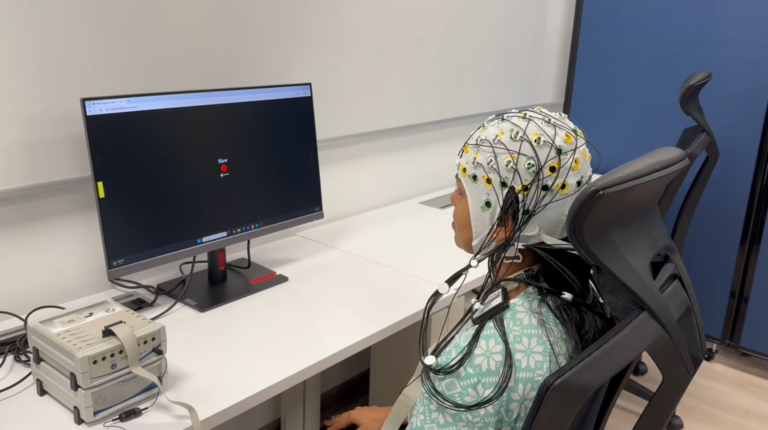
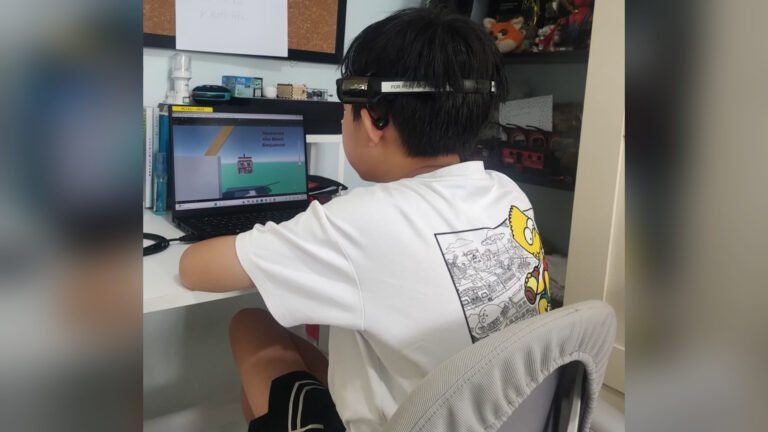
This project develops an EEG-based Brain-Computer Interface (BCI) neurofeedback system for enhancing cognitive performance in demanding military-training environments. The system uses interactive neurofeedback games to translate real-time EEG correlates of cognition into gameplay feedback, enabling users to regulate their brain states while performing cognitively demanding tasks.
Motivation
Military operations involve complex and high-workload environments that place significant demands on executive functions, situational awareness and sustained cognitive performance. Conventional training does not provide objective, real-time physiological feedback that allows personnel to recognise and regulate their underlying cognitive states during demanding tasks.
EEG-based neurofeedback provides a mechanism for monitoring neural activity in real time and delivering immediate feedback, allowing users to learn to regulate brain states associated with cognitive performance.
Objectives
- Develop interactive EEG-based neurofeedback games that translate neural correlates of cognition into gameplay control features.
- Enhance cognitive performance under task-induced stress using real-time feedback based on EEG spectral band power and concentration metrics.
- Evaluate training outcomes using synchronized EEG measurements and standardized cognitive assessments.
- Quantify improvements in baseline cognitive performance following neurofeedback training.
Developed Neurofeedback Games
Neuro Radar Map
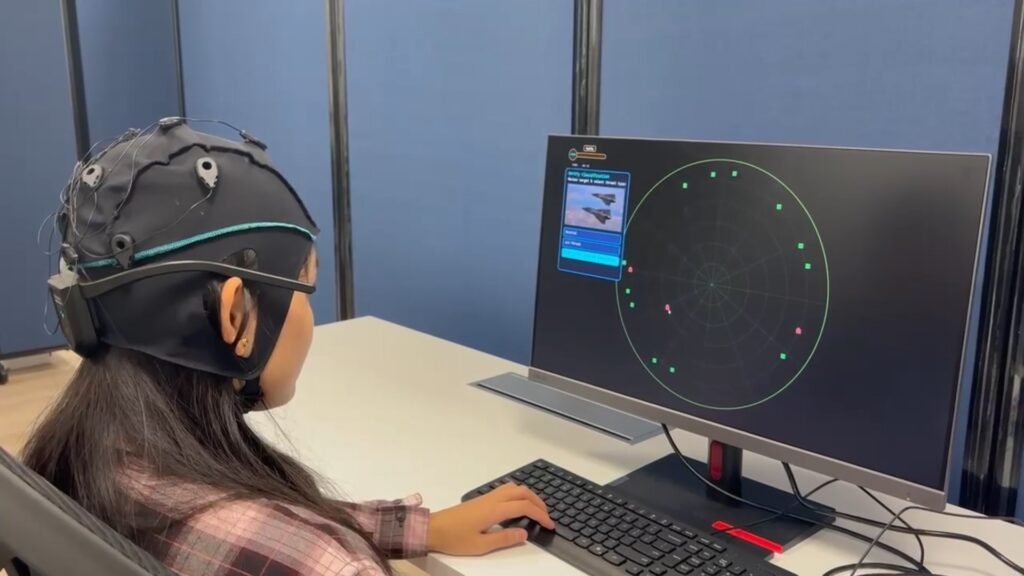
A neurofeedback game designed to train vigilance and working memory within a supervisory radar-monitoring environment.
The game evaluates sustained vigilance, selective attention, threat-classification performance, response inhibition and visuospatial working memory through radar monitoring, threat verification and spatial-recall tasks.
Auto Combat
A real-time 2D tactical command simulation integrated with an online EEG neurofeedback framework. The player manages an automated squad of Unmanned Ground Vehicles while responding to progressively more demanding operational scenarios.
Gameplay adapts according to the user’s neurofeedback state. If the required regulation criteria are not maintained—for example, low SMR or elevated Theta/High-Beta activity—the active simulation pauses, providing immediate feedback that the target cognitive state has been lost.
Technical Approach
EEG signals are acquired and processed to extract neural features associated with the targeted cognitive states. These features are translated into control signals for the neurofeedback application, while visual, auditory or haptic feedback closes the interaction loop.
Within the games, EEG-derived spectral and concentration measures provide real-time feedback, linking the user’s cognitive state directly with gameplay behaviour and encouraging neural self-regulation during cognitively demanding tasks.
Potential Impact
- Enhancement of cognitive performance in healthy adults operating under demanding conditions.
- Training of cognitive functions relevant to high-workload operational environments.
- Objective assessment of neurofeedback-related cognitive improvements using EEG and standardized cognitive measures.
- Development of a scalable neurofeedback framework with potential for deployment in military training facilities and specialized operational units.